24/7 Careline





What is child development?

Child development is a dynamic process in which children develop from total dependence on caregivers in all aspects of functioning during infancy to growing independence in later childhood, adolescence, and adulthood.
A child develops skills over the years in a variety of interconnected domains, including sensory-motor, cognitive, communication and social-emotional.
In order to keep track of these skills during the development period, there are common milestones that your doctor would recommend for each age group. Most children master the skills of each milestone as they age, however, minor, temporary delays in development are expected. Parents should take note in this case as ongoing or continuous delay may be a cause of concern.
A child plays an active role in developing their own skills and their development is greatly influenced by interaction with their surroundings.
Here are some of the functions or skills children would have achieved according to their respective age.
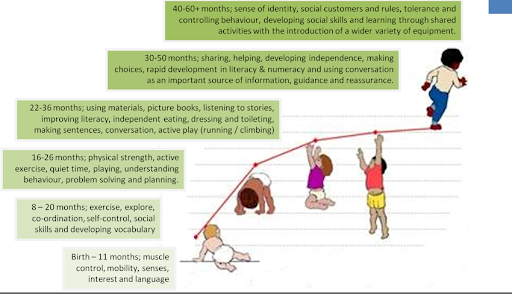
- Birth - 11 months:
- Muscle control
- Mobility
- Senses
- Interest and language
- 8 - 20 months:
- Exercise
- Exploration
- Coordination
- Self-control
- Social skills
- Developing vocabulary
- 16 - 26 months:
- Physical strength
- Active exercise
- Quiet time
- Play
- Understanding behaviour
- Problem solving
- Planning
- 22 - 36 months:
- Using material, picture books
- Listening to stories
- Improving literacy
- Independent eating, dressing and toileting
- Making sentences / conversations
- Active play (running / climbing)
- 30 - 50 months:
- Sharing / helping
- Developing independence and decision making
- Rapid development in literacy, numeracy and conversation
- 40 - 60+ months:
- Sense of identity, social customs and rules
- Tolerance and behavior control
- Social skills through shared activities
What affects a child’s development?
Developmental delays are caused by multifactorial reasons such as poor birth outcomes, inadequate stimulation, malnutrition, chronic ill health, organic problems, or environmental and psychological factors.
While developmental delay may not be permanent, it can provide a basis for identifying children who may experience a disability.
This highlights the importance of early identification and timely intervention with family involvement in a stimulating environment.
The two main areas to observe developmental delays are:
Fine and gross motor skill delay:
Fine motor skills are small movements like holding a toy or drawing. Gross motor skills involve large movements like walking or climbing.
Delay indicators:
- Floppy or stiff limbs
- Inability to sit by 9 months
- More involuntary than voluntary movements
- Unable to bear weight on legs by 1 year
Speech and language delay
The first 3 years are crucial for language development. Delay signs include:
- Not recognizing basic sounds by 6 months
- Not saying 2–3 words by 12–15 months
- Limited sentences by age 3
Language delay involves understanding or expression difficulty, while speech delay is related to vocal tract coordination.
Hearing loss is a common underlying cause and must be checked.
What are the types of disorders that can affect a child’s development?
Common developmental disorders include:
- Autism spectrum disorder (ASD)
- Learning disorders
- ADHD
- Fetal alcohol spectrum disorders
- Language disorders
- Neurological diseases like Cerebral Palsy
- Physical disabilities
What are the signs and symptoms of child developmental disabilities?
These vary but can include delayed motor skills, spasticity, speech/language impairments, poor attention, sensory processing issues, and difficulty with learning or social interaction.
What are the available interventions and therapies?
Parent involvement and a multidisciplinary team are key. Therapies include:
- Physiotherapy – strengthening, posture, gait
- Occupational therapy – sensory, motor, ADL
- CVI therapy
- Speech/language therapy – oromotor, comprehension
- Behavioural therapy
- Early Intervention Program (EIP)
- Community/social activities
- Nutrition and dietary guidance
- Alternative: hippotherapy, hydrotherapy
Rehabcentric at Ara Damansara Medical Centre offers expert guidance and tailored therapy plans to meet your child’s developmental needs.
Early diagnosis and intervention
Individualized therapy
Multidisciplinary approach